Testserver
Class Description
-
class
server.server.Server¶ The great runtime server for all tests and more. This static class with class methods will be usually run as daemon on the main server. It is used to control the other routers, flash the firmwares and execute such as evaluate the tests. The web server and cli instances are connecting with this class and using its inherit public methods of
ServerProxy.-
classmethod
control_switch(router_ids: typing.List, switch_all: bool, on_or_off: bool)¶ Switches the power for different routers on or off.
Parameters: - router_ids – List of router IDs
- switch_all – apply to all routers
- on_or_off – true for on, false for off
-
classmethod
delete_test_results() → int¶ Remove all test results.
Returns: Number of deleted results
-
classmethod
get_power_strip() → power_strip.power_strip.PowerStrip¶ Power strip as object, for now only 1.
Returns: Copy of the original object
-
classmethod
get_router_by_id(router_id: int) → router.router.Router¶ Returns a Router with the given id.
Parameters: router_id – Returns: Router
-
classmethod
get_routers() → typing.List¶ List of known router.
Returns: List is a copy of the original list
-
classmethod
get_routers_task_queue_size(router_id: int) → int¶ Returns the size of the task queue including the actual running task.
Parameters: router_id – ID of the router Returns: queue length
-
classmethod
get_running_task(remote_system: network.remote_system.RemoteSystem) → typing.Union¶ Returns which task is running on the given RemoteSystem.
Parameters: remote_system – the RemoteSystem Returns: if no job is running, it returns None
-
classmethod
get_server_version() → str¶ Returns the server version as a string.
-
classmethod
get_task_errors() → typing.List¶ Return a list of task errors.
Returns: A list of tuples with error information
-
classmethod
get_task_queue_description(router_id: int=-1) → [(<class 'int'>, <class 'str'>, <class 'bool'>)]¶ List of waiting and running tasks.
Parameters: router_id – the specific router or all router if id = -1 Returns: List of (router_id, str(Job), job_running)
-
classmethod
get_test_results(router_id: int=-1) → [(<class 'int'>, <class 'str'>, <class 'unittest.result.TestResult'>)]¶ Returns the firmware test results for the router.
Parameters: router_id – the specific router or all router if id = -1 Returns: List of results
-
classmethod
get_test_sets()¶ Returns: Dictionary of Test_Sets
-
classmethod
get_waiting_task_queue(remote_system: network.remote_system.RemoteSystem) → collections.deque¶ Returns the waiting task queue.
Parameters: remote_system – the associated RemoteSystem of the queue Returns: Returns the queue as a collections.deque, filled with RemoteSystemJobClass and RemoteSystemJob and there wait objects. Type: deque[Tuple[Union[RemoteSystemJobClass, RemoteSystemJob], DoneEvent]]
-
classmethod
reboot_router(router_ids: typing.Union, reboot_all: bool, configmode: bool)¶ Reboots the given Routers.
Parameters: - router_ids – List of unique numbers to identify a Router
- reboot_all – Reboots all Routers
- configmode – Reboots Router into configmode
-
classmethod
register_key(router_ids: typing.List, register_all: bool)¶ Sends the public-key of the given Routers to an email that is specified in the config-file.
Parameters: - router_ids – List of unique numbers to identify a Router
- register_all – Register the public-keys of all Routers
-
register_tty(tty_name: str='') → bool¶ Register tty from cli in logging.
Parameters: tty_name – Name of the console Return bool: Success of the register
-
classmethod
router_online(router_ids: typing.Union, update_all: bool, blocked: bool=False) → None¶ Tries to connect to the Router and updates the Mode of the Router.
Parameters: - router_ids – List of unique numbers to identify a
Router - update_all – Is True if all Routers should be updated
- blocked – blocks until it finished
- router_ids – List of unique numbers to identify a
-
classmethod
set_running_task(remote_system: network.remote_system.RemoteSystem, task: typing.Union) → None¶ Sets internally which RemoteSystem executes which Task. It doesn’t run or starts the job on the RemoteSystem!
Parameters: - remote_system – the RemoteSystem
- task – the Task
-
classmethod
set_waiting_task(remote_system: network.remote_system.RemoteSystem, task: typing.Union, done_event: threading.Event=<threading.Event object>) → None¶ Add a task to the waiting Queue of a specific RemoteSystem.
Parameters: - remote_system – the associated RemoteSystem of the queue
- task – task which has to wait
- done_event – event which will be triggered when the task is finished
-
classmethod
setup_web_configuration(router_ids: typing.Union, setup_all: bool, wizard: bool)¶ After a systemupgrade, the Router starts in config-mode without the possibility to connect again via SSH. Therefore this class uses selenium to parse the given webpage. All options given by the web interface of the Router can be set via the ‘web_interface_config.yaml’, except for the sysupgrade which isn’t implemented yet.
Parameters: - router_ids – List of unique numbers to identify a Router
- setup_all – If True all Routers will be setuped via the webinterface
:param wizard
-
classmethod
start(config_path: str='/home/docs/checkouts/readthedocs.org/user_builds/freifunk-testframework/checkouts/master/config') → None¶ Starts the runtime server with all components.
Parameters: config_path – Path to an alternative config directory
-
classmethod
start_job(remote_sys: network.remote_system.RemoteSystem, remote_job: network.remote_system.RemoteSystemJob, wait: int=-1) → bool¶ Starts an specific job on a RemoteSystem. The job will be executed asynchronous this means the method is not blocking. It add only the job to the task queue from RemoteSystem. If you want, that this method wait until the job is executed, you have to set the wait param. Think about that your job has maybe to wait in the queue.
Parameters: remote_sys – The RemoteSystem on which the job will run. If none then the job will be executed on all routers :param remote_job: The name of the test to execute :param wait: -1 for async execution and positive integer for wait in seconds :return: True if job was successful added in the queue
-
classmethod
start_test_set(router_id: int, test_set_name: str, wait: int=-1) → bool¶ Start an specific test on a router.
Parameters: router_id – The id of the router on which the test will run. If id is -1 the test will be executed on all routers :param test_set_name: The name of the test set to execute :param wait: -1 for async execution and positive integer for wait in seconds :return: True if test was successful added in the queue
-
classmethod
stop() → None¶ Stops the server, all running tests and closes all connections.
-
classmethod
stop_all_tasks() → None¶ Stops all running jobs on the RemoteSystems.
-
classmethod
sysupdate_firmware(router_ids: typing.Union, update_all: bool) → None¶ Downloads and copies the firmware to the
Routergiven in the List(by a unique id) resp. to all Routers.Parameters: - router_ids – List of unique numbers to identify a
Router - update_all – Is True if all Routers should be updated
- router_ids – List of unique numbers to identify a
-
classmethod
sysupgrade_firmware(router_ids: typing.Union, upgrade_all: bool, n: bool) → None¶ Upgrades the firmware on the given
Routers.Parameters: - router_ids – List of unique numbers to identify a Router
- upgrade_all – If all is True all Routers were upgraded
- n – If n is True the upgrade discard the last firmware
-
classmethod
update_router_info(router_ids: typing.Union, update_all: bool) → None¶ Updates all the information about the
Router.Parameters: - router_ids – List of unique numbers to identify a
Router - update_all – Is True if all Routers should be updated
- router_ids – List of unique numbers to identify a
-
classmethod
write_in_db(key: str='', test: (<class 'int'>, <class 'str'>, <class 'unittest.result.TestResult'>)=None)¶ Write new entry in database.
Parameters: - key – Database entry key
- test – Tuple with router id, test name and test
-
classmethod
Class Diagram
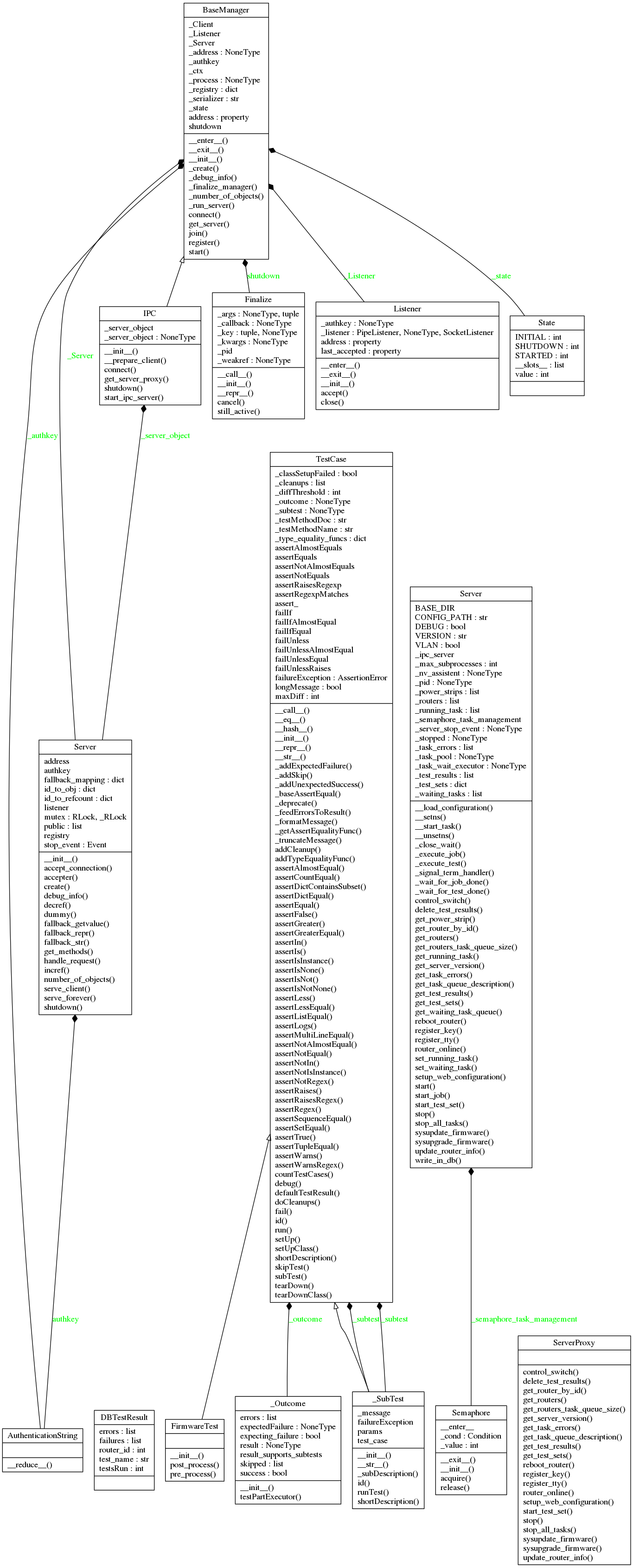
ServerProxy
-
class
server.serverproxy.ServerProxy¶ A proxy model for inter-process communication between the server runtime and clients like CLI and WebServer. Read the method description carefully! The behaviour may be different as expected. Normally the method will be executed remotely on the server and the return value is given by copy and not by reference!
-
classmethod
control_switch(router_ids: typing.List, switch_all: bool, on_or_off: bool)¶ Controls the power on the given port
Parameters: - router_ids – List of router IDs
- switch_all – apply to all routers
- on_or_off – true for on, false for off
-
classmethod
delete_test_results() → int¶ Remove all test results
Returns: Number of deleted results
-
classmethod
get_router_by_id(router_id: int) → router.router.Router¶ Returns a Router with the given id.
Parameters: router_id – Returns: Router
-
classmethod
get_routers() → typing.List¶ List of known routers
Returns: List is a copy of the original list.
-
classmethod
get_routers_task_queue_size(router_id: int) → int¶ Returns the size of the task queue including the actual running task
Parameters: router_id – ID of the router Returns: queue length
-
classmethod
get_server_version() → str¶ Returns the server version as a string
-
classmethod
get_task_errors() → typing.List¶ Return a list of task errors :return: A list of tuples with error information
-
classmethod
get_task_queue_description(router_id: int=-1) → [(<class 'int'>, <class 'str'>, <class 'bool'>)]¶ List of waiting and running tasks.
Parameters: router_id – the specific router or all router if id = -1 Returns: List of (router_id, str(Job), job_running)
-
classmethod
get_test_results(router_id: int=-1) → [(<class 'int'>, <class 'str'>, <class 'unittest.result.TestResult'>)]¶ Returns the firmware test results for the router
Parameters: router_id – the specific router or all router if id = -1 Returns: List of results
-
classmethod
get_test_sets()¶ Returns: Dictionary of Test_Sets
-
classmethod
reboot_router(router_ids: typing.List, reboot_all: bool, configmode: bool)¶ Reboots the given Routers.
Parameters: - router_ids – List of unique numbers to identify a Router
- reboot_all – Reboots all Routers
- configmode – Reboots Router into configmode
-
classmethod
register_key(router_ids: typing.List, register_all: bool)¶ Sends the public-key of the given Routers to an email that is specified in the config-file.
Parameters: - router_ids – List of unique numbers to identify a Router
- register_all – Register the public-keys of all Routers
-
classmethod
register_tty(tty_name: str='') → bool¶ Register tty from cli in logging :param tty_name: Name of the console :return bool: Success of the register
-
classmethod
router_online(router_ids: typing.List, update_all: bool) → None¶ Tries to connect to the Router and updates the Mode of the Router.
Parameters: - router_ids – List of unique numbers to identify a
Router - update_all – Is True if all Routers should be updated
- router_ids – List of unique numbers to identify a
-
classmethod
setup_web_configuration(router_ids: typing.List, setup_all: bool, wizard: bool)¶ After a systemupgrade, the Router starts in config-mode without the possibility to connect again via SSH. Therefore this class uses selenium to parse the given webpage. All options given by the web interface of the Router can be set via the ‘web_interface_config.yaml’, except for the sysupgrade which isn’t implemented yet
Parameters: - router_ids – List of unique numbers to identify a Router
- setup_all – If True all Routers will be setuped via the webinterface
:param wizard
-
classmethod
start_test_set(router_id: int, test_set_name: str, wait: int=-1) → bool¶ Start an specific test on a router
Parameters: - router_id – The id of the router on which the test will run
- test_set_name – The name of the test set to execute
- wait – -1 for async execution and positive integer for wait in seconds
Returns: True if test was successful added in the queue
-
classmethod
stop() → None¶ Shutdown the server
-
classmethod
sysupdate_firmware(router_ids: typing.List, update_all: bool) → None¶ Downloads and copies the firmware to the
Routergiven in the List(by a unique id) resp. to all RoutersParameters: - router_ids – List of unique numbers to identify a
Router - update_all – Is True if all Routers should be updated
- router_ids – List of unique numbers to identify a
-
classmethod
sysupgrade_firmware(router_ids: typing.List, upgrade_all: bool, n: bool) → None¶ Upgrades the firmware on the given
RoutersParameters: - router_ids – List of unique numbers to identify a Router
- upgrade_all – If all is True all Routers were upgraded
- n – If n is True the upgrade discard the last firmware
-
classmethod
update_router_info(router_ids: typing.List, update_all: bool) → None¶ Updates all the information about the
RouterParameters: - router_ids – List of unique numbers to identify a
Router - update_all – Is True if all Routers should be updated
- router_ids – List of unique numbers to identify a
-
classmethod